
# Squid Intents

<figure><img src="https://4247625265-files.gitbook.io/~/files/v0/b/gitbook-x-prod.appspot.com/o/spaces%2FtXbXyuWIO2PwzNc5Dets%2Fuploads%2FLXBTQ8dgckaNzHmOGlht%2F1500x500.jpg?alt=media&#x26;token=79be6d5e-2e11-4efc-86e7-9ec776dbd87d" alt=""><figcaption></figcaption></figure>

## Squid's Intent Swaps Protocol

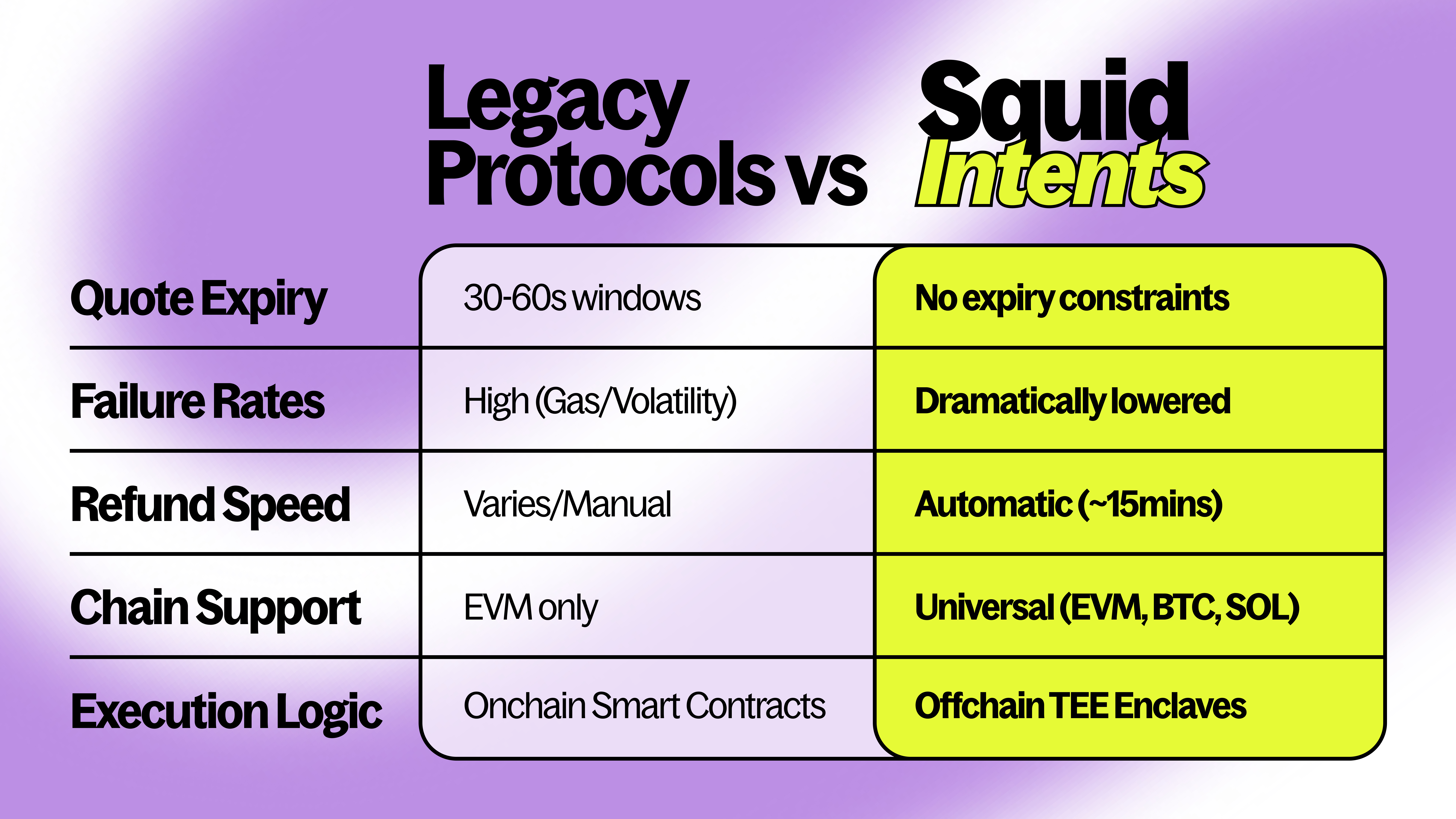
Squid Intents is Squid's intent-based settlement protocol transforming how regular crosschain swaps are executed. It turns user intent into simple onchain transfers and handling complex execution offchain using Trusted Execution Environment (TEE)-verified settlement. Squid Intents offers unparalleled reliability, better pricing, and a smoother user experience across EVM and non-EVM chains alike.

As crosschain logic is handled by TEEs, it delivers efficiency while maintaining the decentralized and non-custodial nature of the protocol while ensuring that Squid can expand to any chain and any token, including chains that don’t have smart contracts.

Squid’s TEEs are powered by [Cubist](https://cubist.dev/blog/squid-launches-sub-second-cross-chain-swaps-enabled-by-cubists-new-private-smart-contract-tech), who we chose for their formidable security background, having secured over $10B USD already, and their commitment to crypto's original values: decentralization and privacy. Their approach ensures high availability, censorship resistance, and decentralized upgrade and deployment pathways for protocols developing on their platform.

### Why Squid Intents?

* Sub-5 second execution for most transactions
* Zero slippage guaranteed through direct market maker integration
* 90% reduction in gas costs compared to traditional AMM-based routing
* MEV protection built into the protocol architecture
* No route expiry: routes don't expire, submit your transaction at any time after receiving a quote
* 15-minute refunds: if a transaction fails, funds are automatically returned on the source chain
* Integrator fee support built in

<figure><img src="https://4247625265-files.gitbook.io/~/files/v0/b/gitbook-x-prod.appspot.com/o/spaces%2FtXbXyuWIO2PwzNc5Dets%2Fuploads%2FFwHS9jfjnoiFZEVbtpnl%2F1920x1080.jpg?alt=media&#x26;token=17de455a-d2dd-4685-b8d0-56c89231d51b" alt=""><figcaption></figcaption></figure>

### Squid Intents Competitive landscape

<table data-header-hidden><thead><tr><th width="134.73046875">Feature</th><th>Squid Intents</th><th>Across Protocol</th><th>deBridge (DLN)</th><th>UniswapX</th><th>NEAR Confidential</th><th>Circle CCTP</th></tr></thead><tbody><tr><td><strong>TEE-Verified Settlement</strong></td><td>✅</td><td>❌</td><td>❌</td><td>❌</td><td>✅</td><td>❌</td></tr><tr><td><strong>Post-Deposit RFQ Auctions</strong></td><td>✅</td><td>❌</td><td>❌</td><td>❌</td><td>❌</td><td>❌</td></tr><tr><td><strong>Native Bitcoin Support</strong></td><td>✅</td><td>❌</td><td>❌</td><td>❌</td><td>❌</td><td>❌</td></tr><tr><td><strong>Native Solana Support</strong></td><td>✅</td><td>✅</td><td>✅</td><td>❌</td><td>❌</td><td>✅</td></tr><tr><td><strong>Native XRPL Support</strong></td><td>✅</td><td>❌</td><td>❌</td><td>❌</td><td>❌</td><td>❌</td></tr><tr><td><strong>Guaranteed 15-Min Refunds</strong></td><td>✅</td><td>❌</td><td>❌</td><td>❌</td><td>❌</td><td>❌</td></tr><tr><td><strong>No Route Expiry</strong></td><td>✅</td><td>✅</td><td>✅</td><td>✅</td><td>✅</td><td>✅</td></tr><tr><td><strong>Multisig Compatibility</strong></td><td>✅</td><td>✅</td><td>✅</td><td>✅</td><td>✅</td><td>✅</td></tr><tr><td><strong>Zero-TVL Architecture</strong></td><td>❌</td><td>❌</td><td>✅</td><td>❌</td><td>❌</td><td>❌</td></tr><tr><td><strong>MEV-Resistant Privacy</strong></td><td>❌</td><td>❌</td><td>❌</td><td>❌</td><td>✅</td><td>❌</td></tr></tbody></table>

### How It Works

Squid Intents uses the `/v2/route` endpoint as all Squid transactions. For **EVM-to-EVM** swaps, the flow is identical to a standard Squid integration — request a route, execute it, and poll for status.

The route response's `transactionRequest` object will include a `transaction_request_type` field that indicates how to execute:

* `"ON_CHAIN_EXECUTION"` — standard on-chain transaction (EVM)
* `"DEPOSIT_ADDRESS_CALLDATA"` — submit a deposit to the provided address with the specified calldata (non-EVM)
* `"DEPOSIT_ADDRESS_WITH_SIGNATURE"` — submit a signed deposit to the provided address (non-EVM)

### Getting Squid Intents Enabled

Squid Intents is not enabled by default. To get started:

1. If you don't already have a Squid integration, [apply for an integrator ID](https://squidrouter.typeform.com/integrator-id)
2. Contact the Squid team to enable Squid Intents on your integrator ID
3. Follow the [Integrating Squid Intents](https://docs.squidrouter.com/api-and-sdk-integration/coral-intent-swaps/integrating-squid-intents) guide

{% hint style="warning" %}
**Widget Users**: Coral V2 requires `@0xsquid/widget` version **6.5.0 or newer**. Please ensure your widget is updated before enabling Coral V2.
{% endhint %}

### Supported Chains

Squid Intents currently supports the following chains:

**EVM Chains**: Celo, BNB Chain, Citrea, Peaq, HyperEVM, Avalanche, Optimism, Arbitrum, Linea, Berachain, Polygon, Gnosis, Base, Sonic, Hedera, XRPL EVM, Soneium, Blast

**Coming Soon**: Bitcoin, Solana


---

# Agent Instructions: Querying This Documentation

If you need additional information that is not directly available in this page, you can query the documentation dynamically by asking a question.

Perform an HTTP GET request on the current page URL with the `ask` query parameter:

```
GET https://docs.squidrouter.com/api-and-sdk-integration/coral-intent-swaps.md?ask=<question>
```

The question should be specific, self-contained, and written in natural language.
The response will contain a direct answer to the question and relevant excerpts and sources from the documentation.

Use this mechanism when the answer is not explicitly present in the current page, you need clarification or additional context, or you want to retrieve related documentation sections.
